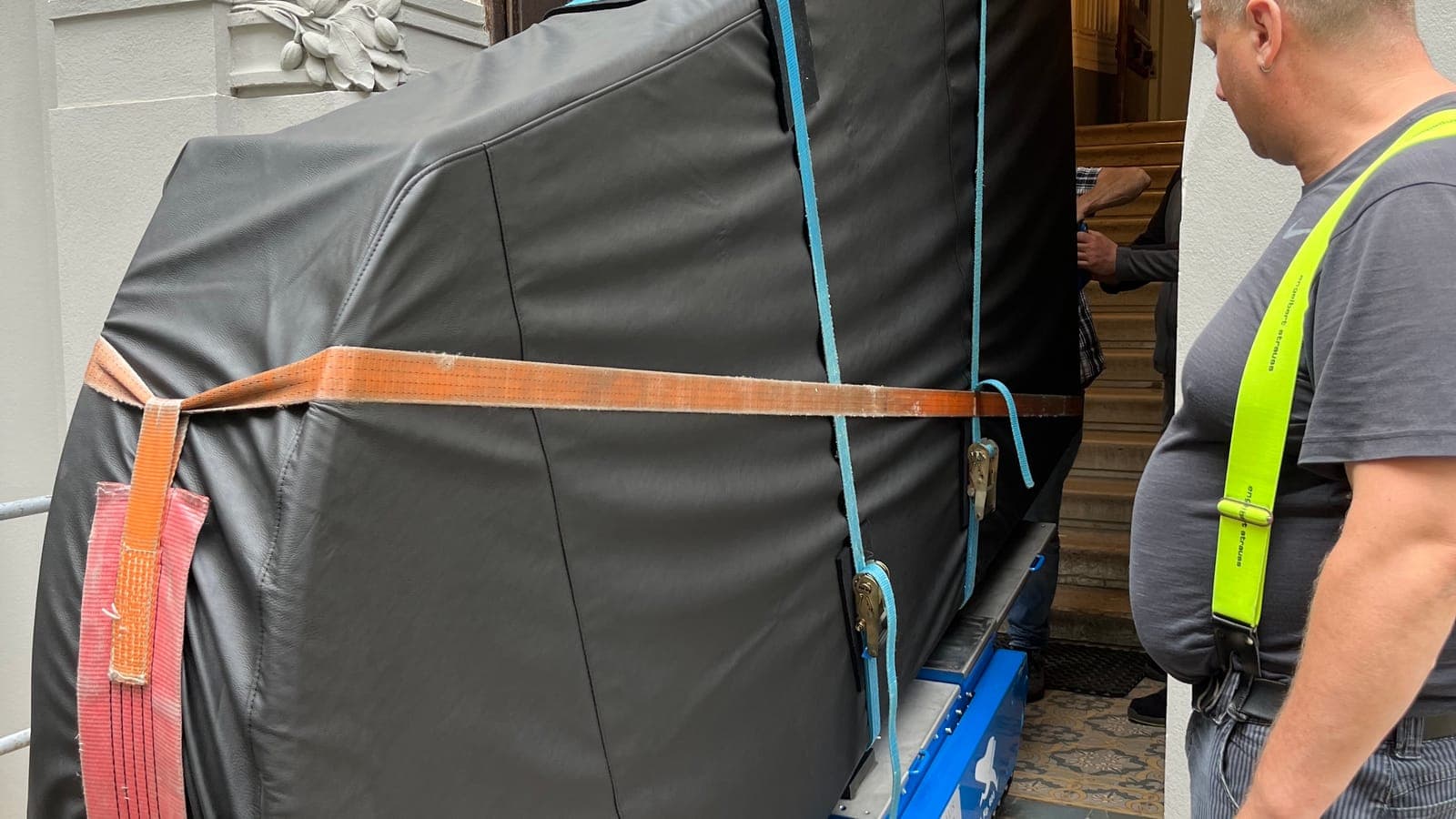
Piano Transport Vienna
Piano transport in Vienna means Gründerzeit Altbau without elevators, tight stairwells in the 1st district, short-term parking zones around the Ring and concert deliveries to the Musikverein and State Opera — from upright pianos to 290 cm concert grands.
1,691,000 residents
Wien
8 music venues
Piano transport in Vienna takes more than a van and strong arms. From the Vienna State Opera on the Ringstraße and the Musikverein in the Inner City to the hundreds of conservatories and private households spread from Donaustadt to Liesing, Piano Shift moves upright pianos, baby grands and concert grands safely through one of the most musical cities in the world. We know the quirks of Vienna's old buildings without elevators, the short-term parking zones, the tight stairwells in the 1st district and the typical courtyard passageways in municipal housing. Every transport is planned in advance — stairs, elevator, crane or courtyard — so your instrument reaches its destination unharmed.
City Highlights
What shapes piano transport in Vienna — the venues, organisers and building types Piano Shift works with regularly:
- Piano transport to the Musikverein, Konzerthaus and Vienna State Opera
- Grand and concert grand transport for Bösendorfer, Steinway and Yamaha instruments
- Gründerzeit Altbau in Josefstadt, Mariahilf and Alsergrund — often without an elevator
- Crane solutions for high floors and narrow Viennese courtyards
- Over 200 music schools, conservatories and the mdw as recurring clients
- Austria's largest piano-transport volume — all 23 municipal districts
What makes piano transport in Vienna special?
Piano transport in Vienna comes with specific requirements — from building age and stairwell geometry to delivery time windows. We plan for these points in advance:
Old buildings without elevators and narrow, winding stairwells
Short-term parking and resident-only zones in districts 1 to 9
No-stopping permits and loading-zone clearance for bulky grand pianos
Low courtyard passages and gateways in municipal housing
Pedestrian zones and road closures around the Ring and Inner City
Delivery time windows and loading ramps at the major concert halls
Concert halls and music institutions in Vienna
Piano Shift regularly delivers to the following concert halls and music institutions in Vienna. Delivery times and stage access are coordinated with the venue's stage management in advance.
Vienna State Opera
Vienna Musikverein (Golden Hall)
Vienna Concert House
University of Music and Performing Arts Vienna (mdw)
MuTh — concert hall of the Vienna Boys' Choir
Bösendorfer Hall at the Mozarthaus
Palais Auersperg
Kursalon Hübner
How much does piano transport in Vienna cost?
A standard piano transport in Vienna starts at € 186,- incl. 20% VAT — starting prices, ground-floor to ground-floor within the city. The exact price depends on floor, elevator, distance and date.
| Instrument | Price from |
|---|---|
| Upright piano | € 186,- |
| Grand piano (180 cm) | € 228,- |
| Concert grand | € 420,- |
All prices include 20% VAT. Floors without elevators, distance outside Vienna and express jobs (within three days) are charged on top.
Calculate exact priceService Area
We serve Vienna and the entire surrounding area with professional piano transport.
Frequently asked questions about piano transport in Vienna
How much does a piano transport in Vienna cost?
A standard piano transport within Vienna starts at € 186,- (incl. 20% VAT). Floors without an elevator, grand pianos instead of upright pianos and express jobs within three days incur surcharges. You can calculate the exact price in seconds with our piano transport cost calculator.
How do you transport a piano over several floors without an elevator?
We use multi-layer padded protective blankets, at least four independent ratchet straps, and a powered piano dolly that can handle even the narrow stairwells of Vienna's old buildings. We charge a fixed surcharge per floor for both pickup and delivery — for especially narrow or inaccessible stairwells we use a crane instead.
How quickly can you schedule a transport in Vienna?
In Vienna we can usually schedule a transport within a few business days. For jobs within three days of the request we add a 50% express surcharge on the subtotal — so short-notice moves, concert deliveries and emergencies are usually still possible.
Do you also transport grand pianos and concert grands?
Yes. We transport baby grands (180 cm), salon grands (190 cm), semi-concert grands (230 cm) and full concert grands with dedicated specialist equipment. For Vienna concert venues like the Musikverein and Konzerthaus we routinely use climate-controlled vans and experienced grand-piano drivers.
Piano transport across the Vienna districts
Vienna spans 23 municipal districts with markedly different building stock — from elevator-free Gründerzeit Altbau to modern Donaustadt buildings with underground garages. We cover the 8 districts with the densest piano history in detail below.
1. Innere Stadt
The 1st district combines Vienna's densest pre-Gründerzeit and Gründerzeit building stock with the UNESCO World Heritage zone around Stephansplatz, Graben and Hofburg. Addresses often sit in pedestrian zones or resident-permit areas — delivery requires a pre-approved time slot, usually early morning or late afternoon. Stairwells are often narrow and without an elevator; many buildings have courtyard passageways with low gateways. We check every address in advance for gate height, turning radius and whether a piano crane from the street will be needed.
4. Wieden
Wieden sits compactly between Karlsplatz, Hauptbahnhof and Wiedner Hauptstraße — predominantly Gründerzeit, interspersed with 1950s and 60s reconstruction buildings. Short-term parking applies across the board. Events at Karlsplatz and ongoing construction around Hauptbahnhof regularly cause short-notice delivery restrictions. The TU Vienna student area drives high rental turnover and a steady flow of piano transports in and out of student flats — we plan deliveries in advance with resident notice and set up no-parking signage where needed.
7. Neubau
Neubau between Mariahilfer Straße, Neubaugasse and Burggasse is quintessential Vienna old-town — the vast majority of residential buildings are Gründerzeit, many without elevators. Districts 6 and 7 have the highest share of pianos on upper floors without a lift in all of Vienna. Delivery operates within the short-term parking zone with resident permits; courtyard passageways are narrow and some addresses strictly require a crane. We charge a fixed stair surcharge per floor for both pickup and delivery.
8. Josefstadt
Josefstadt is Vienna's smallest and one of its densest districts — almost entirely Gründerzeit between Lange Gasse, Josefstädter Straße and Skodagasse. Historically many piano dealers and piano makers settled here, a legacy that still produces an above-average piano density per household. Proximity to the University of Vienna and the Theater in der Josefstadt shapes the clientele. Because of narrow one-way streets and ubiquitous short-term parking, delivery requires careful planning of the no-parking time slot.
9. Alsergrund
The 9th district stretches from Sigmund-Freud-Park and the Old General Hospital (Campus) to the Danube Canal and Liechtenstein Park. Late Classicism and Gründerzeit buildings shape the educated-bourgeois quarter around Berggasse, the university quarter and the Liechtenstein Palace. Around the new General Hospital, temporary delivery restrictions apply due to emergency and patient transport. We use Berggasse and Türkenstraße as main arteries, coordinate hospital-adjacent appointments with local traffic restrictions, and factor in floor surcharges for the many elevator-free Altbau addresses.
13. Hietzing
Hietzing stretches from Schönbrunn Palace across the Lainzer Tiergarten to Speising — a district of contrasts. Gründerzeit villas around Hietzinger Hauptstraße, cottage-style houses in Lainz, and detached villas with private driveways along the edge of the game preserve dominate the picture. The main challenge is the hillside terrain around Speising and the Vienna Woods edge: narrow access roads, tight turning areas, partly accessible only with all-wheel drive in winter. Addresses with a private garage simplify delivery substantially; classic Gründerzeit courtyard passageways need clarification in advance.
18. Währing
Währing is the cottage district par excellence — between Türkenschanzpark, Pötzleinsdorfer Schlosspark and Gentzgasse, detached villas from the first and second cottage building phase stand alongside classic Gründerzeit tenements. Cottage addresses often have stair entrances without elevators, narrow front-garden driveways and tight access lanes. We plan cottage-address deliveries with a site visit or Street View pre-check and clarify turning areas and front-gate dimensions in advance. The Gründerzeit addresses along Währinger Straße follow the typical Vienna Altbau pattern with a courtyard passageway and short-term parking.
19. Döbling
Döbling stretches from the Karl-Marx-Hof in Heiligenstadt to the Heuriger hillsides of Grinzing, Sievering and Nußdorf. Beethoven spent several summers in Heiligenstadt — many of the historic houses still hold pianos from the original furnishings. The hillside terrain around Kahlenberg and Cobenzl brings specific challenges: narrow Heuriger lanes with one-way regulation, tight turning areas, road salt and frost at turn-around points in winter. For hillside addresses we use all-wheel-drive vans and, when needed, site visits to confirm the turning circle.
We also transport pianos in all 15 remaining districts:
- 2. Leopoldstadt
- 3. Landstraße
- 5. Margareten
- 6. Mariahilf
- 10. Favoriten
- 11. Simmering
- 12. Meidling
- 14. Penzing
- 15. Rudolfsheim-Fünfhaus
- 16. Ottakring
- 17. Hernals
- 20. Brigittenau
- 21. Floridsdorf
- 22. Donaustadt
- 23. Liesing
Concert deliveries in Vienna — logistics of the main halls
Vienna is one of Europe's densest concert cities. For the venues below we have built up delivery and coordination practice from regular collaboration.
Musikverein
Delivery traditionally runs through the stage side at Bösendorferstraße / Karlsplatz via the artists' and freight entrance. Time slots sit outside rehearsal and concert hours — usually in the morning or between the dress rehearsal and the evening concert. The Großer Saal is climate-controlled at a constant level; the stage instruments are normally house-owned. External private deliveries chiefly concern rehearsal rooms and the Brahms-Saal. Coordination runs with the stage manager and venue administration in advance; one to two days' notice is mandatory. We use a climate-controlled vehicle since the temperature gap between outside and concert hall is significant in winter.
Wiener Konzerthaus
Deliveries to the Wiener Konzerthaus run via the loading zone at Lothringerstraße or Am Heumarkt, with a freight elevator to the respective hall — Großer Saal, Mozart-Saal, Schubert-Saal or Berio-Saal. Time slots fall outside concert build-ups, usually in the morning. The in-house climate control keeps the halls stable; for external delivery we recommend 24-48 hours of acclimatisation before the first touch. Coordination runs through the stage managers and the technical lead of each hall. Concert grands are then moved onto the stage with in-house piano dollies — we bring the instrument as far as the loading ramp.
Wiener Staatsoper
Deliveries to the Vienna State Opera primarily concern coaching rooms, rehearsal stages and backstage areas — the main stage uses house-owned concert grands. Access runs via the artists' gate on Operngasse, with strict security registration 48 hours in advance, a named driver and a delivery note. Freight elevators reach the rehearsal floors. Delivery slots are coordinated tightly with the stage-tech department and security; spontaneous deliveries are ruled out. We use a climate-controlled vehicle here too, since rehearsal rooms run on a different climate curve than the main stage.
MuTh
The MuTh — the Vienna Boys' Choir concert hall — sits inside the Augarten (2nd district), a contemporary concert building inside a heritage-protected park. Delivery runs via the Lukasi gate on Obere Augartenstraße; driving inside the Augarten requires authorisation from the park administration. Time slots are typically in the morning. The hall is climate-controlled and seats roughly 400. External deliveries usually accompany solo or guest concerts — coordination runs with the MuTh event office in advance, ideally three to five business days ahead.
Bösendorfer-Saal im Mozarthaus
The Bösendorfer-Saal at Mozarthaus Vienna (Domgasse 5, 1st district) is a small, intimate chamber-music space inside a UNESCO World Heritage building. Delivery runs through the narrow historic stairwell; concert-grand transports usually require a crane from Domgasse, which in turn means a resident no-parking permit and close coordination with the Mozarthaus event office. Time slots are strict and fall outside museum opening hours. The room's microclimate is only moderately controlled — climate-controlled transport immediately before the concert is mandatory so the instrument does not detune through the temperature change.
Vienna as a piano city — music history mirrored in today's piano transport
Vienna is not only a concert city — for over two hundred years it was the centre of life for nearly every major piano composer. Mozart lived and died at Domgasse 5 (1st district); Beethoven changed homes some 60 times during his 35 Vienna years, among them the Pasqualati House on Mölker Bastei and his summer apartments in Heiligenstadt (19th district); Brahms lived for almost 25 years at Karlsgasse 4 next to Karlsplatz. That musical density still produces an unusually high piano density per Viennese household: many Altbau flats still hold pre-war Bösendorfer and Steinway instruments that get moved between districts through inheritances, renovations and address changes. Piano transport in Vienna therefore frequently involves instruments older than the van that carries them.
Piano transport from/to Vienna — Lower Austria & Burgenland
Sankt PöltenNiederösterreich · 57,639 residents
Wiener NeustadtNiederösterreich · 47,878 residents
KlosterneuburgNiederösterreich · 28,107 residents
Baden bei WienNiederösterreich · 26,017 residents
MödlingNiederösterreich · 21,453 residents
Krems an der DonauNiederösterreich · 25,123 residents
SchwechatNiederösterreich · 19,744 residents
PerchtoldsdorfNiederösterreich · 15,289 residents
Tulln an der DonauNiederösterreich · 16,897 residents
EisenstadtBurgenland · 15,000 residents
MattersburgBurgenland · 7,400 residents
Neusiedl am SeeBurgenland · 8,800 residents